
There is no perfect sustainable fabric.
Organic cotton still requires land, water, processing and transport.
Recycled polyester reduces demand for virgin synthetic material but remains plastic and can release microfibres.
Linen may offer strong environmental advantages, but the final result still depends on where the fibre was grown, how it was processed, dyed and finished.
Lyocell begins with renewable cellulose, but forest sourcing and manufacturing technology matter.
The correct question is not:
“What is the most sustainable fabric?”
It is:
“Which material provides the required performance with the most credible sourcing, processing, durability and end-of-life strategy for this specific product?”
Textile Exchange recommends comparing materials within their own categories and considering multiple impact areas, including climate, nature, people, animals and governance, rather than relying on one environmental score or marketing claim.
This guide compares the main lower-impact and responsibly sourced fabric options available to clothing brands in 2026.
Sustainable Clothing Fabrics at a Glance
| Material | Best suited for | Main advantage | Main consideration |
|---|---|---|---|
| Organic cotton | T-shirts, hoodies, underwear and jersey | Familiar feel with certified organic sourcing | Still requires agricultural land and processing |
| Recycled cotton | Sweatshirts, denim, jersey and blends | Uses existing textile or production waste | Fibre quality may limit the percentage used |
| European flax linen | Shirts, trousers, dresses and summer clothing | Durable natural fibre with European traceability options | Wrinkles and has a distinctive dry texture |
| Hemp | Workwear, shirts, trousers and blends | Strong natural fibre with growing European production | Supply and softness vary significantly |
| Lyocell | Dresses, shirts, underwear and soft jersey | Smooth regenerated cellulose with efficient processes available | Responsible forest sourcing must be verified |
| Recycled polyester | Sportswear, outerwear and technical products | Reduces demand for virgin polyester feedstock | Remains synthetic and can release microplastics |
| Responsible wool | Knitwear, coats, tailoring and winter clothing | Durable, insulating natural animal fibre | Animal welfare and farm practices require verification |
| Recycled wool | Coats, knitwear and accessories | Reuses existing wool waste | Colour, fibre length and consistency can be restricted |
| Deadstock fabric | Limited capsules and small collections | Makes use of existing unused material | Difficult to reorder or verify original specifications |
No material is automatically responsible simply because it appears in this table.
The supplier, certification, processing, product design and intended lifespan remain essential.
What Makes a Fabric More Sustainable?
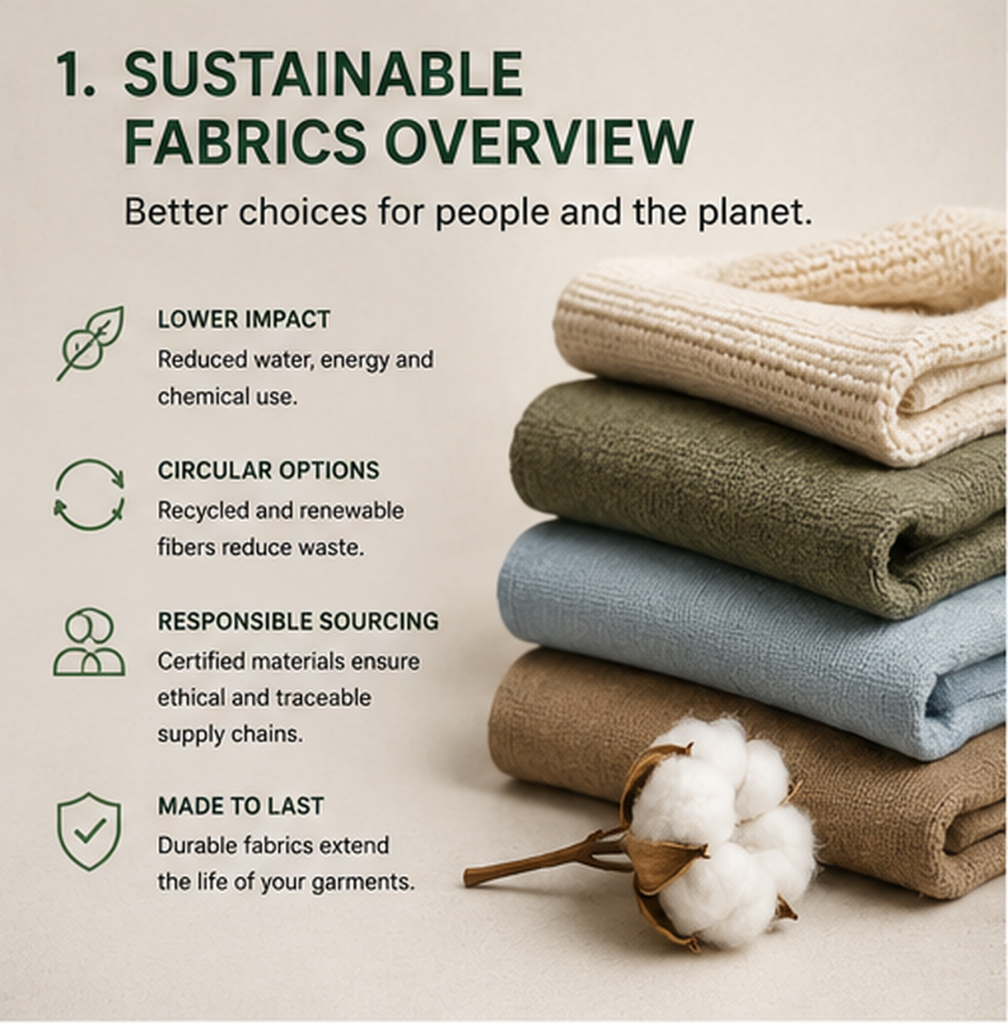
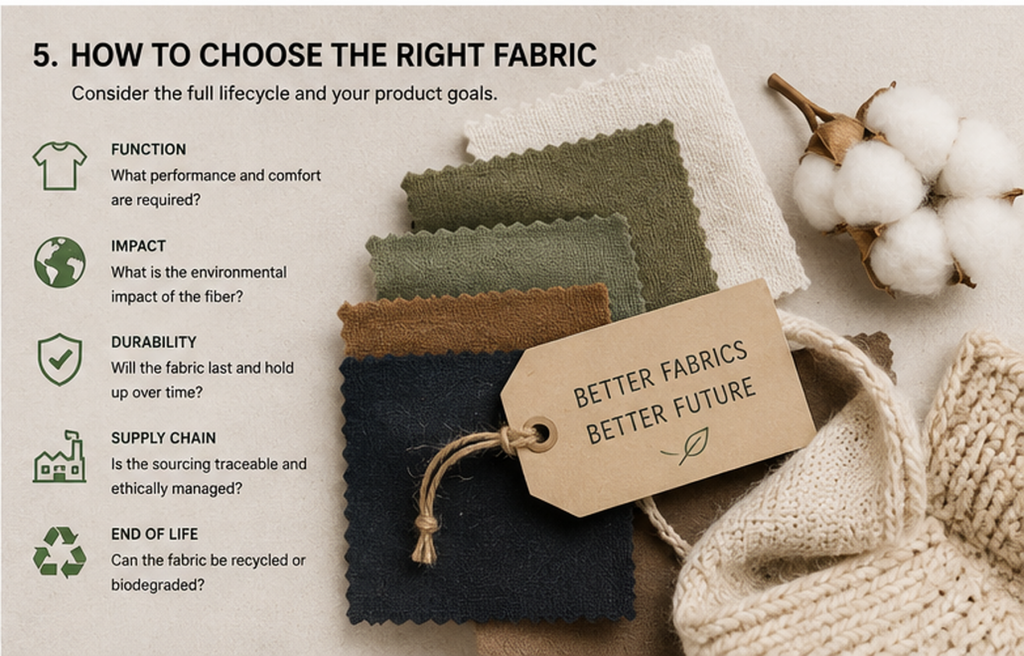
A fabric should be evaluated across its complete life cycle.
Important questions include:
Raw material
- Is the fibre renewable or recycled?
- Where was it grown or collected?
- Is the source traceable?
- Does production affect forests, soil or biodiversity?
- Are animal fibres produced under verified welfare standards?
Processing
- Which chemicals are used?
- Is wastewater treated?
- How much energy is required?
- Is the fabric bleached, dyed, washed or coated?
- Are hazardous substances restricted?
Product performance
- Will the garment last?
- Does it retain its shape?
- Is the colour fast?
- Will customers wear it frequently?
- Can it be repaired?
End of life
- Is the material recyclable?
- Is it blended with other fibres?
- Does it contain elastane, coatings or complex trims?
- Can the garment be disassembled?
- Will it release synthetic microfibres?
Verification
- Is the claim independently certified?
- Is the manufacturer included within the certification scope?
- Is the exact material covered?
- Can the supplier provide transaction documentation?
- Is the certification current?
A product made from a supposedly sustainable fibre can still be poorly designed, overproduced, chemically intensive or discarded after only a few uses.
Material selection is one part of a responsible product strategy.
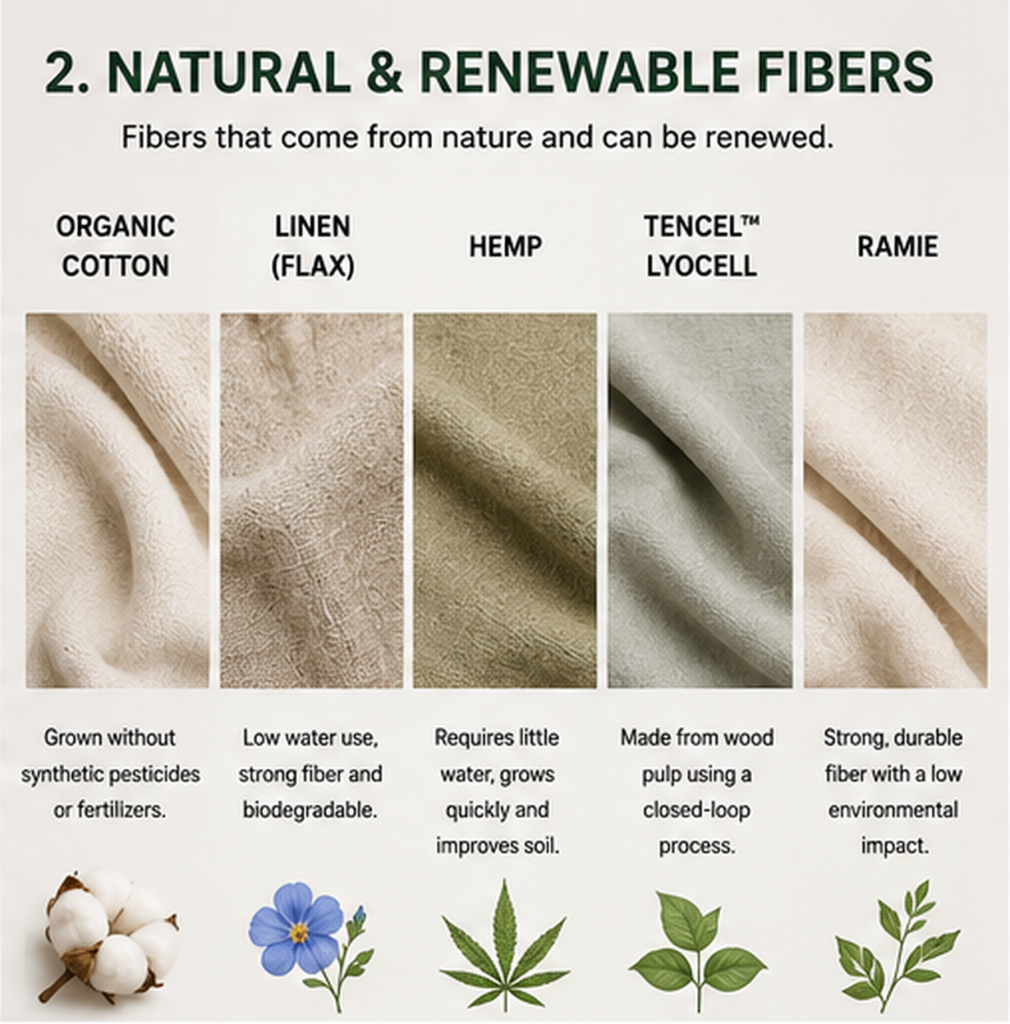
1. Organic Cotton
Best All-Round Option for T-Shirts and Sweatshirts
Organic cotton is one of the most practical materials for brands producing:
- T-shirts
- Hoodies
- Sweatshirts
- Sweatpants
- Underwear
- Pyjamas
- Baby clothing
- Jersey basics
It provides the familiar softness, breathability and printability customers expect from cotton while allowing the agricultural origin to be independently verified.
The current Global Organic Textile Standard Version 8.0, released in 2026, covers organic fibre content together with processing, chemical, environmental and social requirements throughout certified textile production. Products using the GOTS label must include the relevant label grade, approved certification body and certification number.
Advantages of Organic Cotton
Familiar customer experience
Customers already understand cotton.
Organic cotton can be used without changing the basic feel, care or visual identity of products traditionally made from conventional cotton.
Strong decoration potential
Depending on yarn and fabric construction, organic cotton can work well with:
- Screen printing
- DTG printing
- DTF printing
- Embroidery
- Garment dyeing
- Washing
- Enzyme finishing
Suitable for complete collections
The same fibre can be used across:
- Lightweight jersey
- Heavyweight jersey
- French terry
- Brushed fleece
- Rib
- Piqué
- Poplin
- Twill
This makes it easier to create a coordinated product range.
Established certification systems
Brands can source materials certified under systems such as:
- GOTS
- Organic Content Standard
The Organic Content Standard verifies the presence and chain of custody of certified organic material. Unlike GOTS, it does not impose the same additional textile-processing requirements; GOTS also requires a minimum organic content threshold and restricts which other fibres may be blended with it.
Limitations of Organic Cotton
Organic does not mean impact-free.
The fibre still requires:
- Agricultural land
- Water
- Harvesting
- Ginning
- Spinning
- Knitting or weaving
- Dyeing
- Finishing
- Transport
The quality also varies.
An organic cotton garment can still:
- Shrink excessively
- Lose its shape
- Use unstable dye
- Have weak stitching
- Be produced in excessive quantities
- Be designed for a very short trend cycle
Certification verifies specific requirements.
It does not automatically guarantee that the garment is durable, well designed or commercially suitable.
Best certification choices
Choose GOTS when you want broader requirements covering organic fibre, textile processing, chemicals and certified supply-chain stages.
Choose OCS when your main objective is verifying the presence and traceability of organic material and GOTS production is not available.
Do not write “GOTS cotton” merely because the farm or yarn supplier has a certificate.
The parties handling and selling a labelled GOTS product need to meet the applicable certification and chain-of-custody requirements.
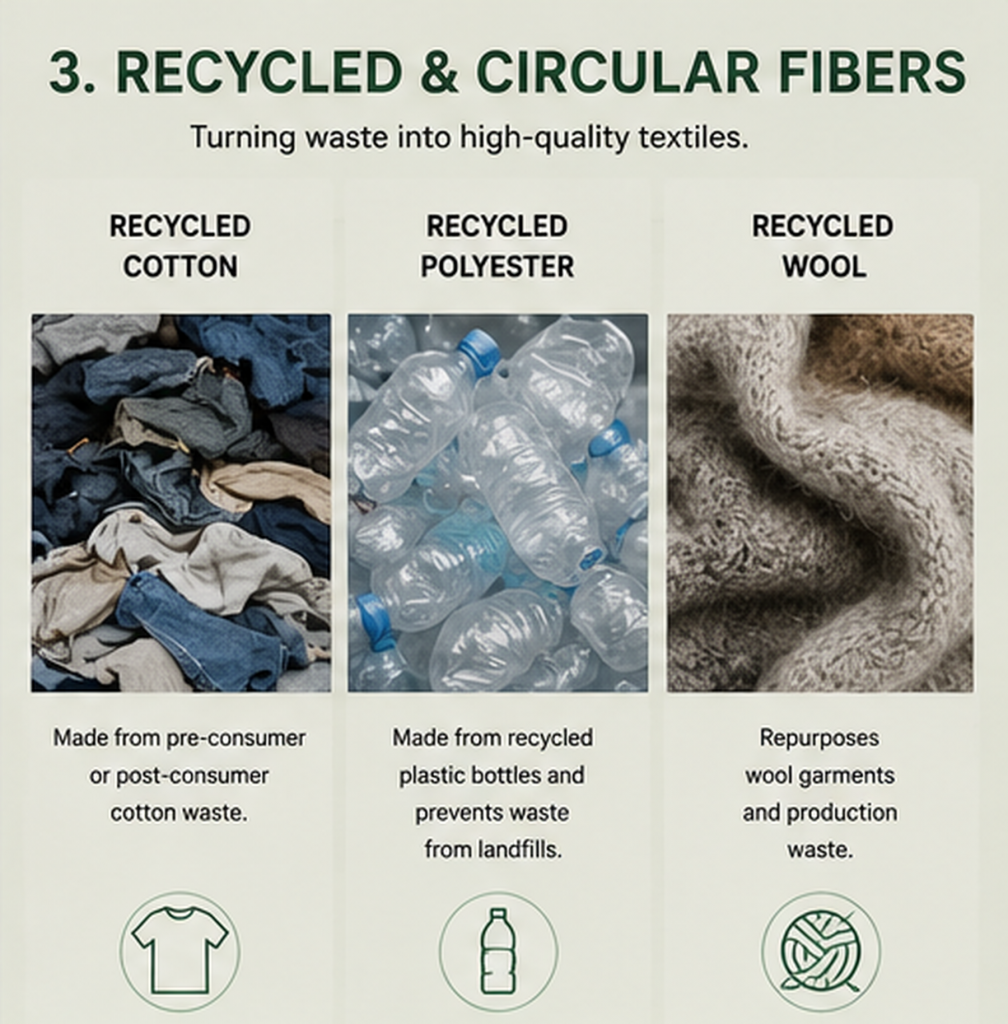
2. Recycled Cotton
Best for Reducing Reliance on Virgin Fibre
Recycled cotton may come from:
- Cutting-room waste
- Yarn waste
- Unused fabric
- Defective garments
- Post-consumer clothing
The waste is sorted and processed back into fibre that can be spun into new yarn.
Recycled cotton can be useful for:
- Sweatshirts
- T-shirts
- Denim
- Overshirts
- Workwear
- Tote bags
- Accessories
- Cotton-rich blends
Advantages of Recycled Cotton
Makes use of existing material
Recycled cotton can redirect production scraps or discarded textiles into a new product instead of relying entirely on virgin fibre.
Creates distinctive textures
The recycled fibre may contribute to:
- Mélange effects
- Vintage surfaces
- Irregular colour
- Dry hand feel
- Workwear character
These qualities can support a streetwear or casual aesthetic.
Suitable for fibre blends
Recycled cotton can be blended with:
- Organic cotton
- Conventional cotton
- Recycled polyester
- Responsible wool
- Other fibres
Blending may help achieve the necessary strength, consistency and performance.
Limitations of Recycled Cotton
Mechanical recycling can shorten fibres.
Depending on the input material and intended product, very high recycled-cotton percentages may affect:
- Yarn strength
- Fabric stability
- Surface consistency
- Pilling
- Product durability
Brands should evaluate the actual fabric rather than selecting the highest recycled percentage only because it sounds more sustainable.
Recycled material may also be difficult to sort when the original waste contains:
- Several fibre types
- Elastane
- Prints
- Coatings
- Trims
- Unknown chemical finishes
Certifications to request
The Recycled Claim Standard and Global Recycled Standard provide third-party certification and chain-of-custody requirements for recycled content.
GRS includes additional environmental, social and chemical-processing requirements and uses a higher minimum recycled-content threshold than RCS.
In July 2026, Textile Exchange released GRS Version 5.0 and RCS Version 3.0. Brands sourcing certified materials should confirm which version their supplier currently uses and whether transition rules apply.
3. European Flax Linen
Best for Premium Summer and Lifestyle Collections
Linen is made from flax.
It is commonly used for:
- Shirts
- Dresses
- Trousers
- Shorts
- Blazers
- Overshirts
- Loungewear
- Home textiles
Linen has a recognizable dry texture, natural irregularity and strong association with European summer clothing.
The European flax sector now provides dedicated traceability systems and environmental data designed to help brands assess flax-linen products through recognised life-cycle and Product Environmental Footprint methodologies.
Advantages of Linen
Strong natural character
Linen provides:
- Visible texture
- Natural slubs
- Crisp drape
- Breathable summer positioning
- A premium European appearance
Durable fibre
Well-constructed linen garments can perform strongly over time and often develop a softer hand with continued use and washing.
European sourcing possibilities
Brands can source European-grown flax and use origin and traceability systems such as:
- Masters of FLAX FIBRE
- Masters of LINEN
These systems can help verify where the fibre originates and how it moves through the supply chain.
Works well in blends
Linen can be blended with:
- Cotton
- Organic cotton
- Lyocell
- Wool
- Viscose
- Hemp
Blends can reduce stiffness, control wrinkling and change the drape.
Limitations of Linen
Linen naturally wrinkles.
That is part of its identity, but it may not suit customers expecting a permanently smooth product.
The fabric can also feel:
- Dry
- Crisp
- Irregular
- Less stretchy than jersey
Different stages may occur in different countries:
- Flax cultivation
- Fibre preparation
- Spinning
- Weaving
- Dyeing
- Garment production
“European flax” does not automatically mean that the complete garment was manufactured in Europe.
Ask for the processing locations separately.
4. Hemp
Best for Durable Natural-Fibre Products
Hemp fibre can be used in:
- Shirts
- T-shirts
- Trousers
- Jackets
- Workwear
- Canvas products
- Bags
- Cotton-hemp blends
The European Commission describes textile hemp fibre as similar to linen and notes that the crop can often be grown with little or no use of insecticides, herbicides and fungicides because it is vulnerable to relatively few pests.
Advantages of Hemp
Strong fibre character
Hemp can create fabrics that feel:
- Substantial
- Natural
- Dry
- Durable
- Workwear-inspired
Growing European availability
The area used for hemp-fibre cultivation has increased across the EU, creating more opportunities for European sourcing and development.
Useful in blends
Hemp is frequently combined with cotton or lyocell to improve:
- Softness
- Draping
- Spinning consistency
- Comfort
- Garment appearance
Distinctive brand story
European hemp can support brands positioned around:
- Natural materials
- Workwear
- Craft
- Regional sourcing
- Durable clothing
- Agricultural innovation
Limitations of Hemp
Not all hemp fabrics are soft.
The result depends heavily on:
- Fibre processing
- Yarn
- Blending
- Enzyme treatment
- Washing
- Fabric construction
A poorly developed hemp T-shirt may feel rough or unstable.
Supply can also be more limited than cotton, creating challenges with:
- Colour availability
- Low minimums
- Repeat orders
- Fabric consistency
- Specialist spinning
Always review a physical sample and complete wash testing.
5. Lyocell
Best for Soft Draped Clothing
Lyocell is a regenerated cellulose fibre.
It begins with cellulose pulp, usually sourced from wood, which is dissolved and converted into fibre.
Lyocell is commonly used for:
- Dresses
- Shirts
- Underwear
- Pyjamas
- Soft trousers
- Jersey tops
- Denim blends
- Loungewear
Advantages of Lyocell
Smooth hand feel
Lyocell can create:
- Soft surfaces
- Fluid drape
- Comfortable next-to-skin products
- Refined lightweight garments
- Clean modern silhouettes
Versatile blending
It can be combined with:
- Cotton
- Organic cotton
- Linen
- Hemp
- Wool
- Elastane
A cotton-lyocell blend can feel softer and more fluid than a pure heavyweight cotton product.
Efficient production systems are available
Lenzing reports that its lyocell system recovers 99.8% of the NMMO solvent used to dissolve cellulose. This is a manufacturer-specific process claim and should not automatically be applied to every lyocell supplier.
Limitations of Lyocell
“Made from trees” is not sufficient evidence of responsible sourcing.
Forest-based fibres such as:
- Lyocell
- Viscose
- Modal
- Rayon
should come from traceable, responsibly managed forestry sources.
FSC warns that forest-based textiles are not automatically responsible and that uncertified sourcing can carry deforestation and illegal-logging risks.
The environmental profile also depends on the production technology.
Traditional viscose and modern lyocell do not use identical chemical processes. Lenzing’s published production information, for example, distinguishes direct-dissolution lyocell from the more chemically complex xanthation process used for viscose.
What brands should request
Ask for:
- Fibre producer
- Forest-certification information
- Chain-of-custody documentation
- Pulp origin
- Manufacturing location
- Exact fibre trademark or generic fibre name
- Chemical-management information
Do not describe generic lyocell as TENCEL.
TENCEL is a specific Lenzing trademark, not the general name of every lyocell fibre.
6. Recycled Polyester
Best for Technical and Performance Products
Recycled polyester is commonly made from:
- Plastic bottles
- Industrial plastic waste
- Textile production waste
- Existing polyester textiles
It is used for:
- Sportswear
- Swimwear
- Outerwear
- Fleece
- Linings
- Technical trousers
- Bags
- Performance jersey
Advantages of Recycled Polyester
Reduces reliance on virgin feedstock
Using recycled polyester can reduce the need to produce the same amount of new polyester from virgin fossil resources.
Technical performance
Polyester can provide:
- Quick drying
- Strength
- Dimensional stability
- Lightweight construction
- Stretch when engineered appropriately
- Compatibility with waterproof and technical systems
Established certification
GRS and RCS can verify recycled content and chain of custody.
GRS also adds processing-related environmental, chemical and social requirements.
Limitations of Recycled Polyester
Recycled polyester remains a synthetic plastic fibre.
The European Environment Agency notes that synthetic textiles use non-renewable resources and can release microplastic fibres during manufacturing, use, washing and disposal.
Recycling plastic bottles into clothing also does not automatically create a closed textile loop.
Once the material becomes a garment, it may be difficult to recycle again, particularly when combined with:
- Elastane
- Cotton
- Coatings
- Membranes
- Adhesives
- Complex trims
Recycled polyester is therefore not automatically the best choice for every product.
It is most convincing when its technical properties are genuinely required.
Best practice
Use recycled polyester when the product needs:
- Moisture management
- Fast drying
- High strength
- Weather protection
- Lightweight performance
- Technical stretch
Avoid replacing natural fibre with polyester merely to add the word “recycled” to a product description.
7. Responsible Wool
Best for Knitwear and Long-Life Winter Products
Wool is commonly used for:
- Knitwear
- Coats
- Tailoring
- Scarves
- Socks
- Base layers
- Overshirts
- Winter accessories
It offers natural insulation, elasticity and odour-management characteristics, making it suitable for products intended to remain in use for several seasons.
Advantages of Wool
Strong performance
Wool can provide:
- Warmth
- Shape recovery
- Wrinkle resistance
- Insulation
- Long-term product value
- Repair potential
Suitable for premium products
Responsible wool can support products with:
- Higher retail prices
- Classic styling
- Seasonal continuity
- Lower dependence on short-lived trends
Independent welfare standards are available
The Responsible Wool Standard evaluates animal welfare, land management and social requirements and provides chain-of-custody verification from certified farms through the supply chain.
Limitations of Wool
Wool is an animal-derived fibre.
Brands need to evaluate:
- Animal welfare
- Mulesing policies
- Land management
- Farm traceability
- Scouring
- Dyeing
- Chemical treatments
- Fibre origin
The RWS prohibits mulesing and incorporates animal-welfare, land-management and chain-of-custody requirements.
Wool can also be expensive, sensitive to care and unsuitable for customers who avoid animal-derived materials.
8. Recycled Wool
Best for Coats, Overshirts and Accessories
Recycled wool may come from:
- Production waste
- Old knitwear
- Used coats
- Cutting scraps
- Unused yarn
It can be sorted by colour and processed into new fibre.
Advantages
- Uses existing wool material
- Can reduce the need for new dyeing when colour-sorted
- Works well for textured products
- Suitable for heavier garments
- Supports vintage and heritage aesthetics
Limitations
Recycled wool fibres may be shorter and may require blending with:
- Virgin wool
- Recycled synthetics
- Polyamide
- Other reinforcing fibres
Colour selection may depend on the available waste stream.
Brands should confirm the precise composition rather than marketing the complete fabric simply as “recycled wool.”
RCS or GRS certification may be used to verify the recycled content where the supplier and material fall within the certification system.
9. Deadstock Fabrics
Best for Small Limited Collections
Deadstock generally refers to existing fabric that was produced but not used for its original purpose.
It may include:
- Cancelled orders
- Excess production
- Previous-season stock
- Fabric with small colour variation
- Remaining rolls
- Development material
Advantages
- Makes use of material that already exists
- Can support very small collections
- Provides access to unusual colours or fabrics
- Reduces the need for new fabric production for that specific order
- Can create genuine scarcity
Limitations
Deadstock is not a certification.
The term alone does not explain:
- Why the fabric remained unused
- Its original composition
- Which chemicals were used
- Where it was produced
- Whether it meets current regulations
- Whether more stock exists elsewhere
The biggest operational problem is repeatability.
A product may sell successfully, but the exact fabric may never be available again.
Deadstock is usually better for limited capsules than permanent core products.
Which Fabric Is Best for Each Product?
T-shirts
Best practical options:
- GOTS organic cotton
- Organic cotton and recycled-cotton blends
- Hemp-cotton blends
- Cotton-lyocell blends
For a structured streetwear T-shirt, organic heavyweight cotton is generally easier to develop than pure linen, hemp or lyocell.
Hoodies and sweatpants
Best practical options:
- Organic cotton French terry
- Organic cotton brushed fleece
- Organic and recycled-cotton blends
- Cotton with a limited recycled-polyester percentage where stability is required
Check whether the complete product, rather than only the main fabric, is covered by the intended certification claim.
Activewear
Best practical options:
- GRS recycled polyester
- GRS recycled polyamide
- Responsible cellulosic blends for low-impact activities
- Wool blends for selected base layers
Performance, durability and stretch recovery should remain the priority.
A product that becomes transparent, loses compression or fails after several washes is not a responsible outcome.
Swimwear
Best practical options:
- Recycled polyamide
- Recycled polyester
- Certified synthetic blends
Swimwear normally requires elastane, which complicates recycling.
Focus on:
- Chlorine resistance
- Saltwater resistance
- UV performance
- Shape recovery
- Long-term use
- Verified recycled content
Shirts and dresses
Best practical options:
- European flax linen
- Hemp blends
- FSC-certified lyocell
- Organic cotton poplin
- Organic cotton-linen blends
The choice depends on whether you need structure or fluidity.
Knitwear
Best practical options:
- RWS wool
- Recycled wool
- Organic cotton
- Certified cellulosic yarns
- Responsible animal-fibre blends
Consider pilling, repairability, yarn strength and customer care.
Outerwear
Best practical options:
- Recycled polyester
- Recycled polyamide
- Organic or recycled cotton twill
- RWS wool
- Recycled wool
- Certified insulation materials
A technical jacket may require several materials.
Do not promote the entire product as recycled when only the outer shell contains recycled fibre.
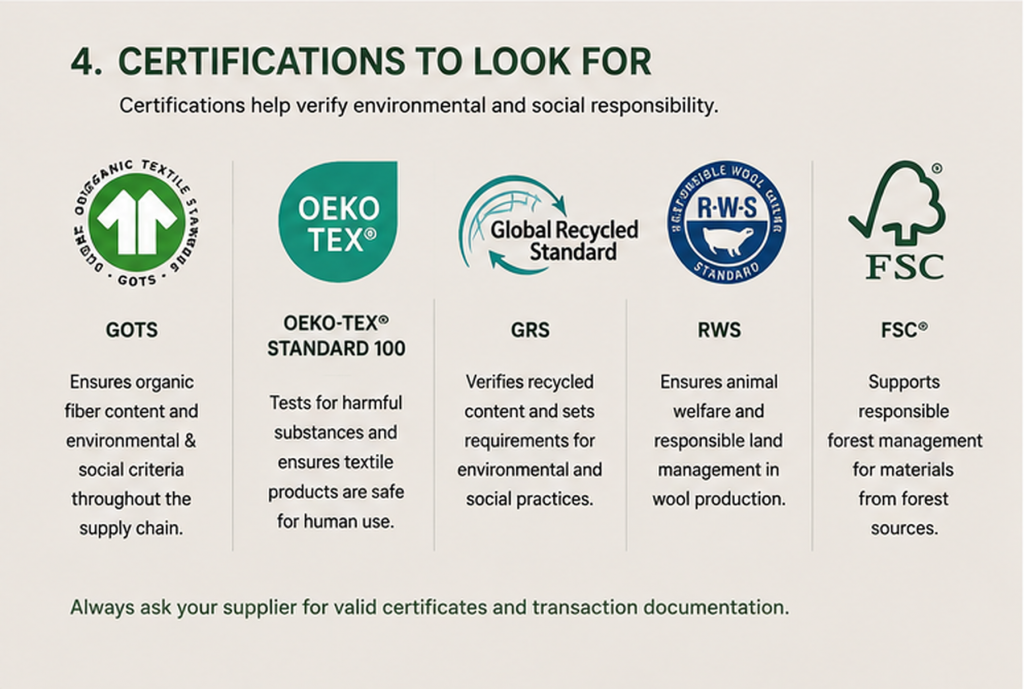
Understanding Textile Certifications
Certifications do not make every decision for your brand.
They provide independent requirements and traceability for specific aspects of the product.
GOTS
Best for:
- Organic cotton
- Organic wool
- Organic-fibre garments
- Broader processing requirements
GOTS Version 8.0 is the current 2026 standard and includes fibre-content, processing, chemical, social and labelling requirements.
OCS
Best for:
- Verifying organic material content
- Organic supply-chain traceability
- Products where full GOTS processing is unavailable
OCS focuses primarily on the presence and chain of custody of certified organic material.
GRS
Best for:
- Recycled polyester
- Recycled cotton
- Recycled wool
- Products with significant recycled content
- Additional processing requirements
GRS includes recycled-content verification, chain of custody and environmental, chemical and social criteria.
RCS
Best for:
- Verifying recycled content
- Lower recycled-content percentages
- Simpler chain-of-custody needs
RCS Version 3.0 applies to products containing at least 5% recycled content under the standard’s eligibility rules.
FSC
Best for:
- Lyocell
- Viscose
- Modal
- Rayon
- Paper packaging
- Hang tags
FSC certification can help verify that forest-based materials originate from responsibly managed sources and controlled supply chains.
RWS
Best for:
- Wool
- Knitwear
- Tailoring
- Coats
- Wool accessories
RWS covers animal welfare, land management, social requirements and material chain of custody.
EU Ecolabel
The EU Ecolabel for textile products considers fibre sourcing, pollution during production, restrictions on hazardous substances and final-product durability. It can apply to textile clothing, accessories, fibres, yarns, fabrics and knitted panels.
Certification Changes Brands Should Know in 2026
Textile Exchange is transitioning several existing standards into its new Materials Matter Standard.
The new standard becomes effective on 31 December 2026 and mandatory from 31 December 2027. Current Textile Exchange standards can continue to be used during the transition period.
This means brands should ask suppliers:
- Which certification version do you currently use?
- When does your certificate expire?
- How are you managing the Materials Matter transition?
- Will the material remain eligible for the same claims?
- Are new transaction certificates required?
- Which company in the supply chain owns the certificate?
Do not assume that a certificate issued several years ago remains current.
How to Verify a Certified Fabric
Before making a public claim, request:
1. Scope certificate
This identifies:
- Certified company
- Certification body
- Standard
- Certified activity
- Validity period
- Product categories
2. Transaction certificate
This connects a specific shipment or commercial transaction to certified material.
A general factory certificate does not automatically prove that your particular order used certified fabric.
3. Fabric composition
Confirm:
- Exact fibre percentages
- Recycled or organic percentage
- Elastane content
- Lining
- Ribbing
- Trims
4. Product claim approval
Certification logos and wording have specific usage rules.
Do not place a certification logo on:
- Packaging
- Hang tags
- Website pages
- Garment labels
- Marketing campaigns
without confirming that you are authorized to use it.
5. Certificate validity
Check:
- Certification number
- Issuing body
- Expiry date
- Certified site
- Approved product scope
A PDF bearing a green logo is not sufficient evidence by itself.
Sustainable Fabric Claims to Avoid
Avoid vague statements such as:
- 100% sustainable
- Completely eco-friendly
- Zero impact
- Planet-positive fabric
- Environmentally harmless
- The world’s greenest cotton
- Saves the planet
- Biodegradable clothing
These claims are difficult or impossible to prove without a clearly defined comparison and methodology.
Use precise statements instead.
Better
Main fabric contains 80% GRS-certified recycled polyester.
Better
Made from 100% GOTS-certified organic cotton through a certified supply chain.
Better
Main fabric uses FSC-certified lyocell.
Better
Produced in Portugal using European flax certified for origin and traceability.
State exactly:
- Which component
- Which material
- Which percentage
- Which certification
- Which production stage
Do not allow one certified trim or small fibre percentage to represent the environmental performance of the complete garment.
Common Material-Sourcing Mistakes
Choosing the highest recycled percentage without testing
The product must still provide the required strength, fit and durability.
Assuming natural always means sustainable
Cotton, wool, linen and viscose can all carry significant impacts when sourcing and processing are poorly managed.
Assuming recycled always means circular
A recycled fibre may not be recyclable again after blending, coating or garment construction.
Ignoring dyes and finishing
A responsible raw fibre can still undergo chemically intensive processing.
Using too many fibre blends
Complex blends can improve performance but make recycling more difficult.
Overproducing sustainable garments
Certified fabric does not make unsold inventory harmless.
Focusing only on the main fabric
Labels, elastics, zips, thread, lining and packaging also form part of the product.
Failing to plan reorders
A rare deadstock fabric may be unsuitable for a permanent bestseller.
Trusting screenshots of certificates
Verify certificates and connect them to the actual order.
Marketing before receiving documentation
Do not publish the environmental claim while the supplier documentation is still incomplete.
How to Build a More Responsible First Collection
A new brand does not need ten experimental materials.
Begin with a focused fabric strategy.
Option 1: Organic Cotton Essentials
Products:
- 180 GSM organic cotton T-shirt
- Heavyweight organic cotton T-shirt
- Organic cotton French-terry hoodie
- Matching sweatpants
Advantages:
- Easy customer understanding
- Consistent care
- Strong printing potential
- Coordinated fabric story
- Suitable for streetwear and lifestyle brands
Option 2: Natural Summer Capsule
Products:
- European linen shirt
- Linen-cotton shorts
- Hemp-cotton T-shirt
- Lyocell-linen trousers
Advantages:
- Natural texture
- Warm-weather positioning
- Strong European visual identity
- Distinctive fabric selection
Option 3: Responsible Active Capsule
Products:
- GRS recycled-polyester performance top
- Recycled-polyamide shorts
- Organic cotton warm-up sweatshirt
- RWS merino base layer
Advantages:
- Materials selected according to function
- Reduced reliance on virgin synthetics
- Clear separation between technical and natural products
Questions to Ask Your Fabric Supplier
Fibre
- What is the exact composition?
- Is the material virgin, recycled or organic?
- What percentage is certified?
- Where does the fibre originate?
Fabric
- What is the GSM?
- Is it knitted or woven?
- Has it been pre-shrunk?
- Which finishes were applied?
- What are the shrinkage and pilling results?
- Is it available for repeat orders?
Certification
- Which standard applies?
- Can you provide a current scope certificate?
- Can you issue transaction documentation?
- Is the full product certified or only the fibre?
- Can the certification logo be used?
Processing
- Where was the yarn spun?
- Where was the fabric knitted or woven?
- Where was it dyed?
- How is wastewater managed?
- Which chemical-management system is used?
Commercial information
- What is the MOQ?
- What is the minimum per colour?
- What is the price per metre or kilogram?
- What is the sample lead time?
- What is the bulk-production lead time?
- Is the fabric permanently stocked?
Frequently Asked Questions
What is the most sustainable fabric for clothing?
There is no universally most sustainable fabric.
The best option depends on the product, sourcing, processing, durability, customer use and end-of-life pathway.
Is organic cotton sustainable?
Certified organic cotton can provide a more verifiable agricultural and processing route than unverified cotton.
However, the final garment still requires energy, water, dyeing, sewing and transport.
Is recycled polyester sustainable?
It can reduce the demand for virgin polyester, but it remains synthetic and may release microplastic fibres.
It is most appropriate when synthetic performance is genuinely required.
Is linen more sustainable than cotton?
Linen can offer strong environmental and durability characteristics, particularly when sourced through a traceable European flax supply chain.
A direct comparison still depends on farming, processing, garment design and use.
Is lyocell better than viscose?
Lyocell can use a more direct dissolution process with high solvent recovery in advanced production systems.
However, fibre producer, forest sourcing and manufacturing technology must be verified.
Is bamboo fabric sustainable?
Most soft “bamboo fabric” sold for clothing is regenerated viscose produced from bamboo cellulose rather than mechanically processed bamboo fibre.
The sustainability claim should therefore be evaluated according to forest sourcing, chemical processing and the actual generic fibre name.
What certification is best for organic cotton?
GOTS is suitable when the brand wants organic fibre together with broader processing and supply-chain requirements.
OCS is useful mainly for organic-content verification and traceability.
What certification is best for recycled fabric?
GRS provides recycled-content verification plus additional processing requirements.
RCS focuses on recycled-content verification and chain of custody.
Can I call a garment sustainable without certification?
You can describe specific, verifiable product characteristics.
Certification is not the only form of evidence, but vague environmental claims should still be supported by credible documentation.
Are natural fabrics biodegradable?
Some untreated natural fibres may biodegrade under suitable conditions.
The complete garment may not behave in the same way when it contains:
- Synthetic thread
- Elastane
- Printing
- Coatings
- Zips
- Labels
- Chemical finishes
Avoid describing a complete product as biodegradable without appropriate testing.
Is deadstock sustainable?
Using existing material may avoid ordering new fabric for that collection.
However, deadstock does not automatically verify composition, processing or environmental impact.
Can sustainable fabrics be low MOQ?
Sometimes.
Stock fabrics and existing private label products generally offer lower minimums than custom-developed certified fabrics or custom colours.
Final Answer: Which Sustainable Fabric Should Your Brand Choose?
Choose organic cotton when you need:
- Familiar comfort
- T-shirts and sweatshirts
- Strong printability
- A simple customer message
- Established certification
Choose recycled cotton when you need:
- Waste-based material
- Vintage texture
- Cotton-rich blends
- Casual or workwear products
Choose European linen when you need:
- Premium summer products
- Natural texture
- European traceability
- Shirts, dresses and trousers
Choose hemp when you need:
- Strong natural character
- Durable clothing
- Workwear positioning
- Innovative European sourcing
Choose certified lyocell when you need:
- Softness
- Fluid drape
- Next-to-skin comfort
- Dresses, shirts or loungewear
Choose recycled polyester or polyamide when you need:
- Technical performance
- Swimwear
- Activewear
- Outerwear
- Fast drying and durability
Choose responsible or recycled wool when you need:
- Warmth
- Knitwear
- Coats
- Repairable long-life products
- Premium winter positioning
The most responsible decision is not always the most unusual fabric.
It is often a well-documented material that performs correctly, remains available for reorders and allows the customer to use the garment for a long time.
Start with the product’s function.
Select a traceable material.
Verify the documentation.
Test the finished garment.
Produce realistic quantities.
Then communicate only the claims you can prove.
Private Label Clothes helps brands develop customizable clothing collections in Portugal. Contact the team to discuss available fabrics, certification requirements, minimum quantities and the most appropriate material for your product.
Choose materials with evidence—not only a sustainability story.
