
Private label.
White label.
Blank apparel.
Custom manufacturing.
The clothing industry uses these terms constantly, often as though they all mean exactly the same thing.
They do not.
The difference matters because it affects:
- How much you can customize
- How quickly you can launch
- How much inventory you need
- How much the product costs
- Whether competitors can sell the same garment
- How much control you have over quality
- How distinctive your brand can become
In simple terms:
White label clothing is a ready-made product that multiple brands can purchase and sell under their own names.
Private label clothing is produced or customized specifically for one brand, with greater control over branding, colours, decoration and product details.
Both models can be useful.
The correct choice depends on whether you want to test an idea quickly or build a clothing brand with a more recognizable product.
Private Label vs White Label Clothing at a Glance
| Factor | White label clothing | Private label clothing |
|---|---|---|
| Product development | Already developed | Existing product customized for your brand |
| Exclusivity | Low | Medium to high |
| Branding | Basic relabelling | Custom labels and branding |
| Colours | Usually stock colours | Stock or selected custom colours |
| Printing and embroidery | Often organized separately | Frequently included in production |
| Garment construction | Usually fixed | May allow selected adjustments |
| Minimum quantity | Very low or no MOQ | Generally higher |
| Setup time | Very fast | Moderate |
| Unit price | Usually lower initially | Usually higher |
| Brand differentiation | Limited | Stronger |
| Best for | Testing, merchandise and quick launches | Building a long-term clothing brand |
The exact meaning can vary between suppliers.
One manufacturer may describe a service as private label even when it offers only a standard blank with a custom neck label. Another may allow extensive changes to colours, fabrics, fit and finishing.
Always ask what is actually included.
Do not rely only on the terminology.
What Is White Label Clothing?
White label clothing is a pre-existing garment produced for general resale.
The same T-shirt, hoodie or pair of sweatpants can be purchased by multiple companies. Each buyer may add its own logo, label or packaging and sell the product under a different brand name.
The original product is not developed specifically for any one company.
A typical white label process looks like this:
- A supplier produces a standard garment.
- The garment is offered to multiple buyers.
- A brand purchases the product from available stock.
- The brand adds a print, embroidery or label.
- The finished garment is sold under the brand’s name.
For example, ten different clothing brands may buy the same black oversized T-shirt from one blank supplier.
Each brand applies different artwork, but the underlying garment remains identical.
Common White Label Products
White label clothing often includes:
- Basic T-shirts
- Oversized T-shirts
- Hoodies
- Sweatshirts
- Sweatpants
- Shorts
- Polo shirts
- Caps
- Tote bags
- Socks
- Activewear
- Underwear
- Promotional apparel
These products are normally available in established colours, sizes and fits.
The buyer selects from what already exists rather than developing new specifications.
Advantages of White Label Clothing
1. Fast Launch
Because the garments already exist, you do not need to wait for patterns, samples or fabric development.
You can purchase stock, decorate it and begin selling relatively quickly.
2. Low Financial Risk
Some white label suppliers allow brands to purchase:
- One unit
- A small size run
- A few dozen pieces
- Products only after receiving customer orders
This reduces the amount of money tied up in inventory.
3. Easy Product Testing
White label products allow you to test:
- A brand name
- A graphic
- A colour
- A target customer
- A retail price
- A marketing campaign
You can collect real customer data before investing in more customized production.
4. Simple Supply Chain
You do not need to coordinate:
- Pattern development
- Fabric sourcing
- Dyeing
- Prototype revisions
- Custom trims
- Complex technical documents
The supplier has already completed these stages.
5. Accessible to Beginners
White label clothing is often suitable for founders with limited manufacturing experience.
You can focus more of your attention on:
- Branding
- Content
- Marketing
- Customer service
- Sales
Disadvantages of White Label Clothing
1. Competitors Can Sell the Same Product
The biggest limitation is lack of exclusivity.
Another company may use the same garment in the same colour and fit.
The only visible difference may be the print or label.
2. Limited Customization
You normally cannot change:
- Pattern
- Fabric
- GSM
- Sleeve length
- Collar construction
- Hood shape
- Pocket design
- Stitching
- Ribbing
- Garment measurements
You select from the supplier’s existing product.
3. Generic Brand Experience
White label clothing can feel more like branded merchandise than a fully developed fashion product.
This is particularly noticeable when:
- The original label is poorly removed
- The fit is widely used
- The colour selection is generic
- The packaging is basic
- The product lacks distinctive details
4. Inconsistent Stock Availability
A supplier may sell out of:
- Popular colours
- Key sizes
- Specific garments
- Seasonal products
If the product is discontinued, your brand may be forced to find a replacement with a different fit or colour.
5. Limited Control Over Quality
You rely on the supplier’s standard specifications.
Even when the garment is good, you may not have access to detailed information about:
- Fabric origin
- Dyeing
- Shrinkage
- Production location
- Quality-control process
- Certification
- Supply-chain changes
What Is Private Label Clothing?
Private label clothing is manufactured or customized for a specific brand.
The garment may begin as an existing base product, but the final result includes details selected for that customer.
Depending on the manufacturer, private label customization may include:
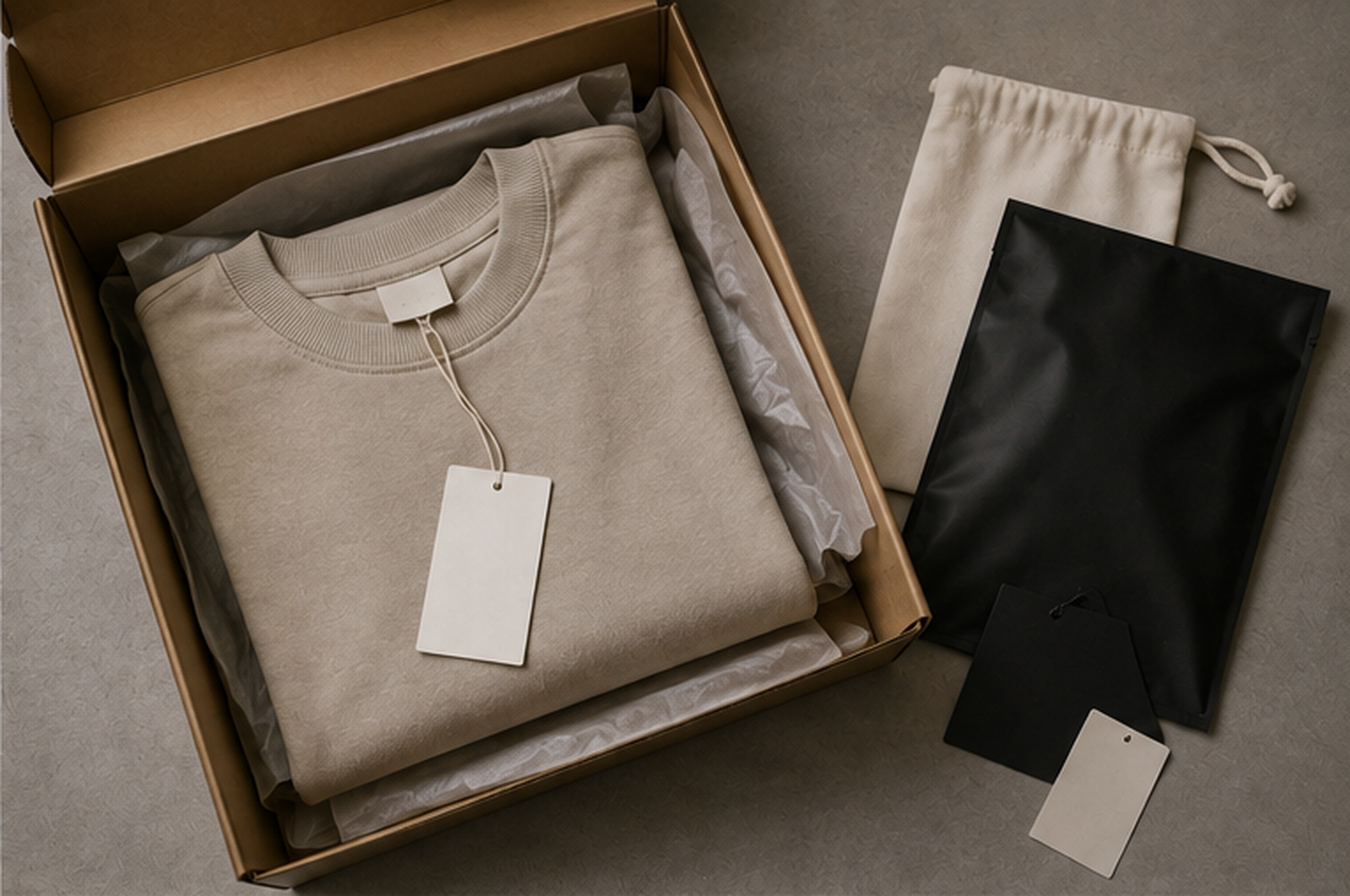
- Custom main labels
- Size labels
- Care and composition labels
- Hang tags
- Printing
- Embroidery
- Selected colours
- Packaging
- Washes
- Fabric options
- Fit selection
- Minor construction changes
- Custom trims
- Product-specific finishing
The final product is presented as belonging completely to the customer’s brand.
Unlike a standard white label order, private label production normally requires the brand to approve the complete specification before manufacturing begins.
A Typical Private Label Process
A private label project may follow these stages:
- The brand chooses a garment.
- The brand selects the colour and sizes.
- Artwork and branding files are submitted.
- Labels and decoration are defined.
- A sample or visual approval is prepared.
- The final specification is confirmed.
- Bulk production begins.
- Quality control is completed.
- The products are packed and delivered.
This process takes longer than purchasing ready-made stock, but it gives the brand greater control over the finished product.
Advantages of Private Label Clothing
1. Stronger Brand Identity
Private label allows the product to carry a complete branding system.
This may include:
- Main woven label
- Custom neck print
- Size label
- Care label
- Hang tag
- Packaging
- Embroidery
- Print placement
- Signature colours
The garment feels like a genuine brand product rather than a decorated blank.
2. Greater Product Differentiation
Depending on the supplier, you may be able to choose:
- Regular or oversized fit
- Fabric weight
- Colour
- Washing
- Decoration technique
- Stitching details
- Label placement
- Packaging
Even when the base garment is not completely custom, these decisions create a more distinctive result.
3. Better Product Consistency
The entire order is usually produced and decorated within one controlled workflow.
This helps maintain consistency across:
- Colours
- Print placement
- Label application
- Embroidery
- Packaging
- Size distribution
4. More Professional Presentation
Customers experience the product as a complete branded object.
They do not see another supplier’s label or generic packaging.
This can support:
- Higher perceived value
- Better content
- Stronger customer trust
- More premium pricing
- Greater repeat-purchase potential
5. Easier Collection Coordination
A private label manufacturer may help coordinate matching products such as:
- T-shirt and hoodie
- Hoodie and sweatpants
- Sweatshirt and shorts
- Multiple colourways
- Shared branding details
This allows a new brand to create a coherent capsule collection.
Disadvantages of Private Label Clothing
1. Higher Minimum Quantities
Private label production normally requires a minimum order because the manufacturer must prepare:
- Labels
- Artwork
- Machinery
- Production schedules
- Packaging
- Quality-control processes
The MOQ may apply:
- Per product
- Per style
- Per colour
- Per design
Always clarify how the minimum is calculated.
2. Higher Initial Investment
The finished unit cost may include:
- Garment
- Printing
- Embroidery
- Labels
- Packaging
- Sampling
- Setup fees
- Shipping
This requires more capital than purchasing undecorated stock.
3. Longer Lead Times
A white label garment may be available immediately.
Private label production can require several weeks because the order must be customized and scheduled.
4. More Decisions
The founder needs to approve:
- Artwork dimensions
- Decoration positions
- Label designs
- Size breakdown
- Colours
- Packaging
- Product details
This is positive for control but requires more preparation.
5. Inventory Risk
Because private label production normally involves bulk quantities, the brand must predict which:
- Sizes
- Colours
- Styles
will sell.
Incorrect size or colour planning can leave money trapped in slow-moving stock.
Is Private Label the Same as Custom Cut-and-Sew?
No.
This is one of the most common areas of confusion.
Private label and custom cut-and-sew can overlap, but they are not automatically the same.
Private Label
Private label normally starts with an existing or previously developed garment.
The brand customizes selected elements, such as:
- Colour
- Embroidery
- Labels
- Packaging
- Finishing
The core pattern and construction may remain unchanged.
Custom Cut-and-Sew
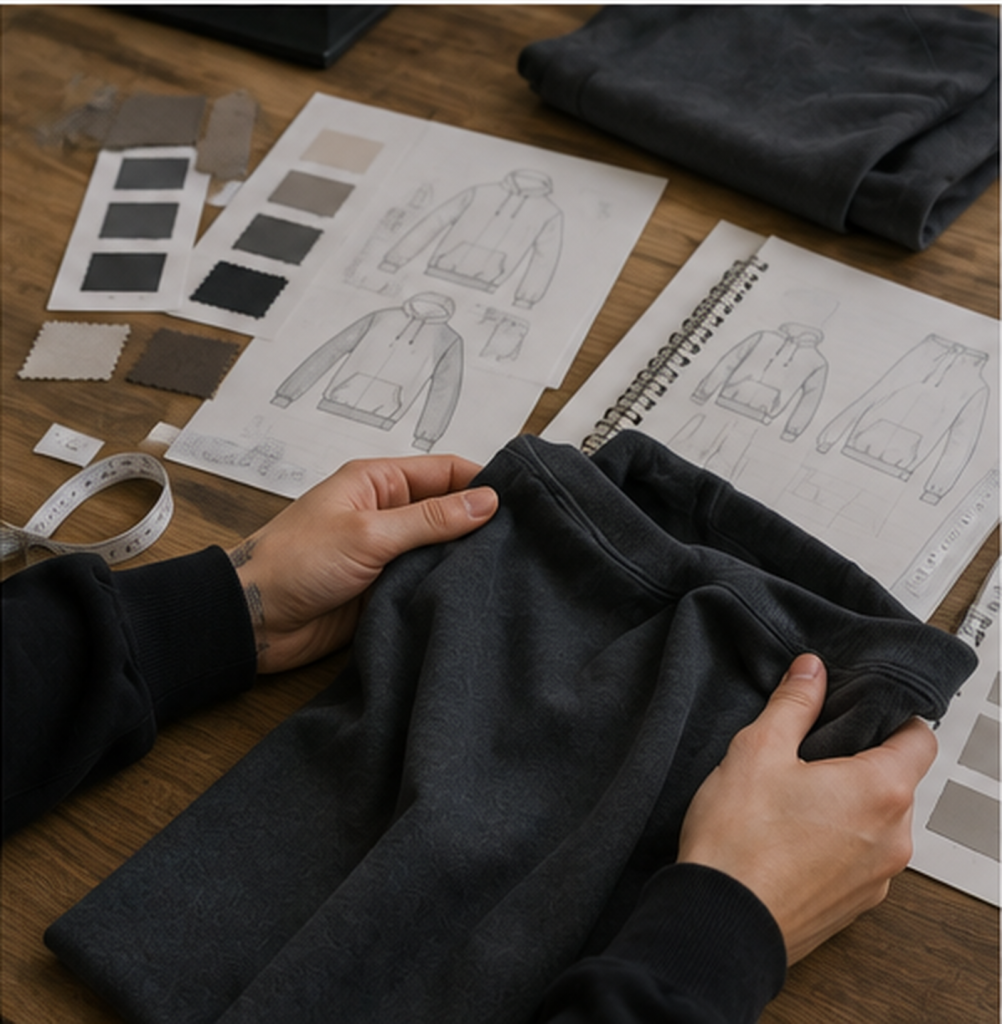
Custom cut-and-sew develops a garment according to your own technical specification.
This can include:
- Original pattern
- Custom measurements
- Specific fabric
- Custom GSM
- Unique construction
- Special pockets
- Custom hood shape
- Unique seam placement
- Custom hardware
- Custom wash
- Original trims
A fully custom project normally requires:
- Technical drawings
- Measurement chart
- Bill of materials
- Pattern development
- Prototype samples
- Fit revisions
- Fabric sourcing
- Higher minimum quantities
- Longer lead times
Simple Example
Imagine that you want to produce a black hoodie.
White label hoodie
You purchase an existing black hoodie from stock and print your logo on it.
Private label hoodie
You select an existing hoodie, choose the colour, add custom labels, embroidery, hang tags and packaging.
Custom cut-and-sew hoodie
You develop your own pattern, body length, shoulder width, hood shape, fabric weight, pocket construction, ribbing and stitching.
Each model provides a different level of control, cost and risk.
Private Label vs White Label vs Print on Demand
Print on demand is another model often confused with white label production.
| Factor | Print on demand | White label | Private label |
|---|---|---|---|
| Inventory | None | Small or bulk stock | Bulk production |
| Production timing | After each sale | Product already exists | Produced for the brand |
| Custom branding | Very limited | Limited | Extensive |
| Unit cost | High | Low to moderate | Moderate |
| Minimum quantity | Usually one | Low or none | Generally higher |
| Product control | Very low | Low | Medium to high |
| Margins | Lower | Moderate | Stronger potential |
| Launch speed | Very fast | Fast | Moderate |
| Best for | Testing graphics | Merchandise and simple brands | Long-term clothing brands |
Print on demand offers the lowest inventory risk.
Private label offers the strongest balance between accessibility and brand control.
How Much Does White Label Clothing Cost?
White label prices depend on:
- Garment type
- Fabric weight
- Supplier
- Production country
- Order quantity
- Decoration
- Shipping
A basic T-shirt may cost only a few euros before printing.
A heavyweight premium blank may cost significantly more.
Additional costs may include:
- Screen printing
- DTG printing
- DTF transfers
- Embroidery
- Relabelling
- Hang tags
- Packaging
- Shipping
The main advantage is that you can often purchase very small quantities.
However, lower quantity usually means a higher unit cost.
How Much Does Private Label Clothing Cost?
Private label pricing includes more elements.
The cost may include:
- Base garment
- Custom colour
- Printing
- Embroidery
- Main label
- Size label
- Care label
- Hang tag
- Packaging
- Setup charges
- Sampling
- Quality control
For example, a simple private label T-shirt will normally cost less than:
- A heavyweight hoodie
- A washed garment
- A multi-colour screen print
- A large embroidery
- A product with several custom trims
The final price also depends heavily on quantity.
A 100-piece order will usually have a higher unit cost than a 500-piece order because setup costs are divided across fewer units.
Which Model Offers Better Profit Margins?
Private label can offer stronger long-term margins, but only when the product and branding justify the higher retail price.
White label may have a lower startup cost, but the product can be harder to differentiate.
Consider this simplified example.
White label product
- Garment: €8
- Printing: €4
- Label and packaging: €2
- Finished cost: €14
- Retail price: €35
Private label product
- Garment and customization: €22
- Packaging and shipping: €3
- Finished cost: €25
- Retail price: €65
The private label product costs more, but it may support a higher retail price because the customer perceives greater value.
However, neither example guarantees profit.
The brand must still pay for:
- Marketing
- Website
- Payment fees
- Returns
- Photography
- Discounts
- Taxes
- Warehousing
- Customer service
A strong margin depends on total costs, not only the manufacturing price.
Which Model Is Best for a New Clothing Brand?
The correct answer depends on what you are trying to test.
Choose White Label When:
- You have a very limited budget
- You want to launch quickly
- You need fewer than 50 units
- You are testing a logo or graphic
- You already have a local printer
- You are creating merchandise
- You are not yet sure whether customers will buy
- Product exclusivity is not a priority
White label is useful when the main goal is validation.
Choose Private Label When:
- You want to build a real fashion brand
- You need custom labels
- You want consistent decoration
- You can order a controlled bulk quantity
- You require professional packaging
- You want a coherent collection
- Product presentation matters
- You want stronger customer loyalty
- You plan to reorder and grow
Private label is usually the better route when the brand intends to operate beyond one temporary release.
Choose Custom Cut-and-Sew When:
- The fit is central to your identity
- Existing garments do not meet your needs
- You require a unique fabric
- Your design includes original construction
- You can support higher MOQs
- You have a larger development budget
- You understand the sampling process
- You are building a long-term signature product
Custom development should solve a real product problem.
Do not pay for a completely new pattern merely to reproduce a standard T-shirt that already exists.
Can White Label Clothing Still Feel Premium?
Yes.
A white label product can still create a strong customer experience when the blank is carefully selected.
The brand should pay attention to:
- Fabric weight
- Fit
- Collar quality
- Stitching
- Shrinkage
- Print technique
- Embroidery
- Relabelling
- Packaging
- Photography
- Styling
A premium blank with strong decoration can feel far better than a badly developed custom garment.
The limitation is not necessarily quality.
It is exclusivity and control.
Can Private Label Clothing Be Sustainable?
Private label production can support a more responsible business model when it is managed carefully.
Potential advantages include:
- Controlled quantities
- Lower inventory waste
- Local or regional manufacturing
- Certified materials
- Better traceability
- Smaller replenishment orders
- Reduced transport distances
- Longer-lasting garments
However, the term “private label” does not automatically guarantee ethical or sustainable production.
Ask the supplier:
- Where are the garments produced?
- Where does the fabric come from?
- Which certifications are available?
- What is the fibre composition?
- How are workers protected?
- Which dyes and chemicals are used?
- Can production be traced?
- What packaging is used?
- How is quality controlled?
Sustainability should be supported by evidence rather than marketing language.
Questions to Ask a Clothing Supplier
Before choosing a private or white label partner, ask:
Product
- What is the fabric composition?
- What is the GSM?
- Is the garment pre-shrunk?
- What fit is available?
- Can I receive a measurement chart?
- Where is it manufactured?
- Which colours are available?
Customization
- Can the neck label be replaced?
- Can you produce custom care labels?
- Do you offer printing?
- Do you offer embroidery?
- Can artwork be placed on the sleeves or back?
- Can I customize the packaging?
- Can the garment colour be changed?
Minimums
- What is the MOQ per product?
- What is the MOQ per colour?
- Does each graphic count as a separate design?
- Can sizes be mixed within the MOQ?
Development
- Can I order a sample?
- How much does sampling cost?
- Can the sample be revised?
- Is sample approval required before bulk production?
Production
- What is the production lead time?
- What quality-control process is used?
- What happens if products are defective?
- How are colours and print placements approved?
Pricing
- Does the quotation include labels?
- Does it include packaging?
- Does it include printing or embroidery?
- Are setup fees included?
- Does it include delivery?
- Are taxes or duties included?
Clear answers at the beginning prevent expensive misunderstandings later.
Common Mistakes When Choosing Between Private and White Label
Choosing Only by Unit Price
A cheaper garment may create higher costs through:
- Returns
- Poor reviews
- Replacement stock
- Low customer retention
- Weak brand perception
Ordering Too Much Too Early
Private label production does not mean you should immediately order thousands of units.
Start with a controlled quantity and scale according to actual demand.
Ignoring Fit
The same logo can look premium on one garment and cheap on another.
Always test the physical product.
Using Another Brand’s Label
A product does not feel fully owned when the original supplier’s label remains visible.
Launching Too Many Products
Each new style and colour creates more inventory risk.
A focused capsule is usually more effective.
Assuming Private Label Means Fully Custom
Ask exactly which changes are possible.
The supplier may offer branding but no pattern or fabric changes.
Skipping Sample Approval
Never approve bulk production using only a digital mock-up.
Print size, placement, fabric colour and embroidery texture can look very different in person.
Example: Building a First Streetwear Collection
Imagine that you want to launch a streetwear brand with:
- One oversized T-shirt
- One hoodie
- One pair of sweatpants
- Black and off-white colours
- Front embroidery
- Back print
- Custom labels
White label route
You purchase garments from one or more blank suppliers.
You then coordinate:
- Printing
- Embroidery
- Label removal
- New label application
- Packaging
- Quality control
This may offer lower minimum quantities, but you need to manage several suppliers.
Private label route
You select the garments and submit:
- Colours
- Size quantities
- Artwork
- Print dimensions
- Embroidery position
- Label artwork
- Packaging requirements
One production partner coordinates the complete product.
This normally requires a higher minimum, but the final collection is more consistent and professional.
Frequently Asked Questions
Is white label clothing legal?
Yes.
A company can purchase clothing from a supplier and sell it under its own brand, provided it follows the applicable labelling, product-safety, tax, trademark and consumer-protection requirements.
The seller remains responsible for the products offered to customers.
Can I put my own label on white label clothing?
Often, yes.
Some products use tear-away labels or are supplied unbranded. Others require the original label to be professionally removed.
You must still provide the legally required composition, care and product information.
Is private label better than white label?
Private label is better for brands that need stronger differentiation, custom branding and a consistent collection.
White label is better for fast testing, very small quantities and lower initial risk.
Is private label expensive?
It costs more initially than purchasing a few ready-made blanks, but it usually costs less than developing a completely custom cut-and-sew garment.
What is the minimum order for private label clothing?
It depends on the product and supplier.
Some manufacturers begin around 50–100 pieces, while custom production may require 200, 300, 500 or more units per style or colour.
Is print on demand white label?
Print on demand is a type of on-demand fulfilment that frequently uses white label garments.
The product is produced or decorated only after the customer places an order.
Can private label clothing have a custom fit?
Some private label suppliers offer several established fits.
Minor adjustments may be possible, but a completely original fit normally requires custom cut-and-sew development.
Which model is best for streetwear?
Private label is often the most balanced option for a new streetwear brand.
It allows the founder to use proven garments while adding custom labels, prints, embroidery, colours and packaging.
Final Answer: Private Label or White Label?
Choose white label clothing when you need:
- Speed
- Very low quantities
- Minimal financial risk
- Simple merchandise
- Fast product testing
Choose private label clothing when you need:
- Stronger branding
- Custom labels
- Professional presentation
- Better consistency
- A complete collection
- A long-term fashion business
Choose custom cut-and-sew when you need:
- An original pattern
- Unique construction
- Custom fabrics
- Signature product development
- Maximum product control
For most new clothing brands, private label offers the strongest middle ground.
It is more distinctive than white label clothing and more accessible than fully custom manufacturing.
You do not need to develop every seam from the beginning.
You need a reliable product, a clear identity and enough control to make the finished garment feel genuinely yours.
Private Label Clothes helps emerging brands create customizable T-shirts, hoodies, sweatpants and shorts in Portugal with custom artwork, labels and branding.
Start with a proven garment.
Add your identity.
Build demand before increasing complexity.
Explore our customizable clothing and begin your private label collection.
